Showing posts with label Books. Show all posts

Best Readings


Everyone is looking for the Holy Grail in trading but very few realize that the Holy Grail is not some magical indicator but the ability to recognize a day type early on in the day and then adapt your trading accordingly. Mind Over Markets gives you this and James Dalton's explanation is the most comprehensive and makes this difficult concept much easier to grasp.

In Markets in Profile, Dalton has greatly expanded their scope, delving deeply into the ways in which the auction process reveals the actions of all investor time frames. They believe that by understanding timeframe behavior through developing market structure, it is possible to identify asymmetric opportunities that can ameliorate risk and help ensure financial dominance.

Trading in the Zone introduces a whole new mental dimension to getting an edge on the market. Use it to leverage the power of the 'zone' for unprecedented profit. Mark Douglas says: You need to ‘change your thinking’. The goal is to reach a ‘care-free state of mind’. There’s nothing to think about. Take the trade because you have an edge. Then odds, probability and your risk control mechanisms will take care of everything.

The Disciplined Trader can help any trader change the fear of losing into a winning attitude based on the step-by-step approach for learning the mental skills necessary for accumulating the wealth you desire on a consistent basis.

In the end, the key is to learn more about yourself. The most important lesson though is the importance of viewing every single trade as being part of a series of trades. No magic there, just plain and simple math and a bit of psychology to fight irrational fears. You only have to realize it is a game of probability. That's all.

If you read these books from Dalton and Douglas, you will have covered the most important aspects of trading: Method and Mindset. D+D=M+M
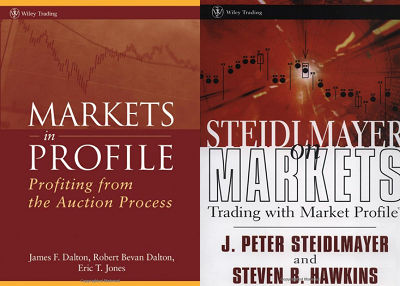
Markets in Profile


Market Profile is not a typical indicator. It does not provide buy/sell recommendations but acts more like a decision-support tool. It organizes the data so that you can understand who is in control of the market, what is perceived as fair value, and the potential direction.

Markets in Profile shows the dynamics of markets through the organization of price, time and volume, and how to synthesize this information with your own intuition. Each day, the market will develop a range for the day and a value area which reflects the acceptance level of a certain price range or balance area. The point of control represents the price where most of the trading activity took place.

Market Profile is based on the normal distribution curve, if you rotate the normal distribution curve so that price is along the vertical axis and time on the horizontal axis, you have the structure of Market Profile. Monitoring price distribution over time gives insight into what levels are considered fair and unfair. You may take advantage of this information and identify good opportunities.

Market Profile can be used to identify the "asymmetric opportunities". These are market set-ups based on anomalies where not only do the odds more favor a move in one particular direction (balanced targets) but the situation is such that a move in that direction is likely to be substantially larger than were the market to go the other way.

Markets in Profile shows it clear that the profile is not some magical technical system. People are generally not prepared to take the time and effort to learn what is essentially an art. This book combines potent theory with real-world examples of how the profile makes it possible to take advantage of these "asymmetric opportunities".

Steidlmayer on Markets lays the foundation for understanding and implementing the Market Profile methodology by providing background information based on Steidlmayer's experiences as a commodities trader, and showing how he developed his ideas and learned to apply them successfully within the markets.

Dalton Unplugged


James Dalton (aka Jim), author of Mind Over Markets, is a discretionary trader and uses the Market Profile to organize the Data. He has over 43 years of experience trading the markets and though he retired from the full time business, he was in Bangkok in 2016 for Traders Carnival to talk about his approach, nuances, tips and common mistakes, as he believes to teach how to catch the fish rather then feeding a fish.

Jim talks about the auction process and how the purpose of the auction is to travel from balance to imbalance and back to balance.

In a two way auction process the market participants of a day time frame tend to play to the exactness of levels and in that process tend to break value area levels by few ticks and come back into value leaving an auction failure. Markets hate precision. The people who are obsessed playing to the exactness of levels can enter into emotional trades and the other players are waiting to jump in so that they can be wiped out.

Most traders are anxiously looking and trying to find a trade, and if you're trying to find a trade, you will probably find a trade but it won't be the right trade. It takes a lot of maturity to understand that if you get into the flow of the market when the trade is right for your timeframe you will recognize it.

He talks about how volume is key. If we break out of a trading range and volume decreases, probably it's not going to be a successful break, but if you break out of that range and volume increases then we've a good chance to get a successful breakout.

Jim mentions the three biggest mistakes most traders do. First mistake is being 'too anxious' to trade in the morning. If we're within yesterday's range in balance we want to have some patience, but if you're outside of yesterday's range the chance for a big day are much higher. Second thing they do is trade 'too often'. Instead of looking for 2-3 trades a day, a lot of these traders are looking for 10 trades a day.

The third big mistake traders make is putting their stops 'too tight'. They believe that they're being prudent by having a tight stop when in fact they add up a series of unnecessary losses. They're spread between bid and offer and all transaction costs and it gets quite expensive.

He use market profile to identify market structure and place the stop near someplace that would violate that market structure. He believes that's the best way to control risk. The worst stop we can use is just the money stop. The second worst thing is move the stop to break-even and that's actually a terrible thing to do because it's random.

He talks about preparation. We should prepare every day by writing three potential scenarios that could happen. The worst trader is a trader that has only one idea. He may get lucky but there's too much randomness in the market. We don't know that's going to happen and if we don't have contingency plans for the unexpected, we're scrambling and when we scramble we do some really silly things.